Making America Hungry Again

I remember well the hungry eyes of Black kids in junior high who watched me with envy as I ate my peanut butter and jelly sandwich in the lunchroom. I had eaten a bowl of cereal that morning. A lot of my classmates had knocked back a can of Coke for breakfast. It was cheap. It filled you up. It raised your blood sugar. And it gave you a hit of caffeine. Lunch was a problem.
“Hey, man! You don’t need to eat that sandwich, do you?” I heard that every day. Sometimes I was hit on for money. “Hey, man. You got two cents?”
I learned to sit closer to the tough plainclothes cop patrolling the lunchroom, and vowed then and there never to defund the police.
But alas, the Great Migration of Blacks from the South of Jim Crow to the North was not what the migrants had hoped for. Racism was as much a problem in West Philadelphia as it had been in rural North Carolina. Jobs were scarce and the combination of white flight and redlining forced Blacks into a ghetto. In 1960, things were getting better, but for 47% of school kids poverty and hunger were seemingly intractable burdens. Then, in 1964 President Lyndon Johnson created the School Lunch program, and better yet, the Food Stamps program in which qualifying families could buy food at supermarkets.
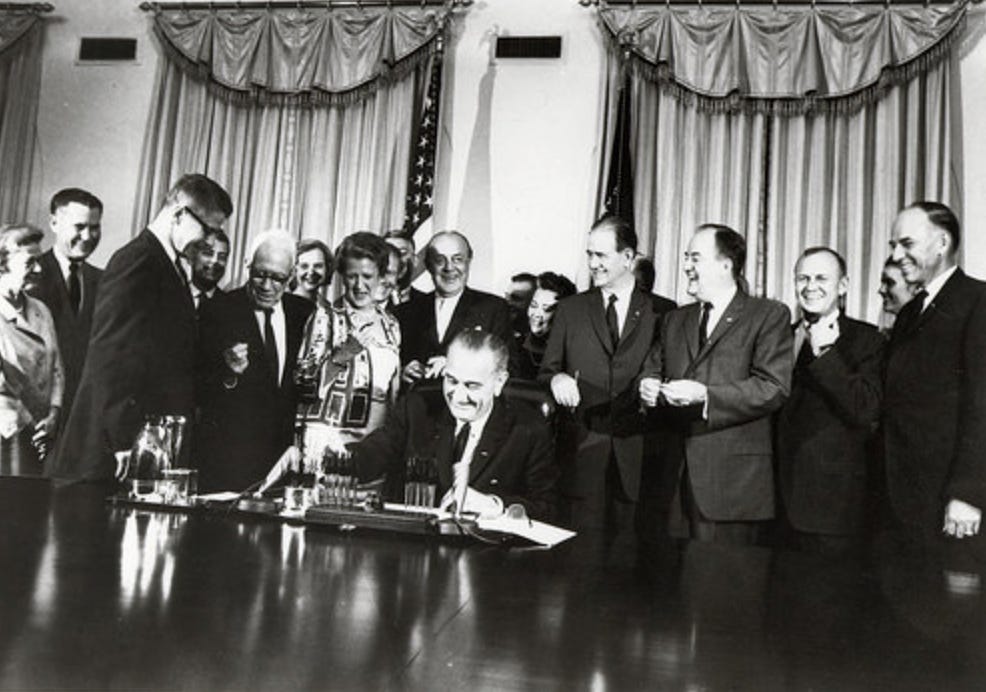
President Lyndon B. Johnson signs the Food Stamp Act of 1964. Photo credit: U.S. Department of Agriculture. Fair use.
My grandmother Matilda used them, handing off to my parents the five pound blocks of Velveeta cheese and bottomless jars of peanut butter her Hungarian palate had no use for. (Note to DOGE: was this “fraud” or “abuse”? I confess. Food Stamp peanut butter is in my DNA. Sue me.)
During the Food Stamp program poverty rates declined. Food insecurity dropped, especially among children. Farmers liked the program, too, because it gave them a market for their surpluses. In 2008 Food Stamps morphed into SNAP, the Supplemental Nutrition Assistance Program. The program was a political hit and grew slowly over sixty years into a 100-billion-dollar a year benefit for its recipients, which, despite its cost, was a model safety net that a good government provided its citizens.
But it was not a hit with everyone. Jimmy Carter, a peanut farmer himself, acted against his own self-interest and cut the school lunch budget in 1980 by 8%. The Reagan administration, not to be outdone by Carter’s fiscal knife, slashed 25% from school lunches the following year, forcing the Agriculture Department to reduce costs by proclaiming to all the world that catsup was a vegetable. The world was not impressed.
Donald Trump, RFK Jr., Russell Vought, Elon Musk, and supine Congressional Republicans saw their chance to do worse and took it. The “One Big Beautiful Bill” took a knife to SNAP and made the deepest cuts to a safety net in American history. In what has become a staple of Donald Trump— the false claim, the bogus charge, or the lawsuit without evidence— his people claimed that SNAP was filled with fraud and waste, that illegal immigrants were on the public dole, even though the libertarian think tank, the Cato Institute, estimated that 4% of all SNAP recipients are non-citizens, compared to 6.5% of the U.S. population. RFK Jr. added the novel claim that the government was using taxpayer dollars to “poison” people. He was referring to sugar products that were causing obesity and diabetes in the poor, though there was weak or no evidence that those problems were significantly worse in SNAP recipients.
RFK Jr. is not alone. In the past twenty years lawmakers in several states have proposed stopping SNAP from paying for bottled water, candy, soda, chips, ice cream, decorated cakes and “luxury meats” like steak. That’s easier said than done. If candy is defined as “any unrefrigerated, flourless preparation of “sugar, honey or other natural or artificial sweeteners in combination with chocolate, fruits, nuts or other ingredients or flavorings in the form of bars, drops or pieces,” Kit Kat and Twix bars, which are made with flour, wouldn’t be banned. As Mr. Bumble in Oliver Twist says, “The law is an ass,” at least in certain states.
But with control of Congress and the Oval Office, the stars were aligned, and the bureaucrats rolled up their sleeves and set to work to make America hungry again. The “One Big Beautiful Bill Act” slashed 186 billion dollars from the SNAP budget over the next ten years. They made benefits contingent on having a job. Working 40 hours a week a single person was not permitted to earn more than $1696 a month, or $10 an hour. Republicans lit the candle of impoverishment on both ends. Earn too much and you lose your benefits. Earn too little and you work for slave wages. To make matters worse, they tossed 75% of the burden of managing the program onto the backs of cash strapped states without helping to pay for it.
What now? SNAP benefits are not keeping up with rising food prices. Enrollment has been steady through 2024, but benefits have been falling.
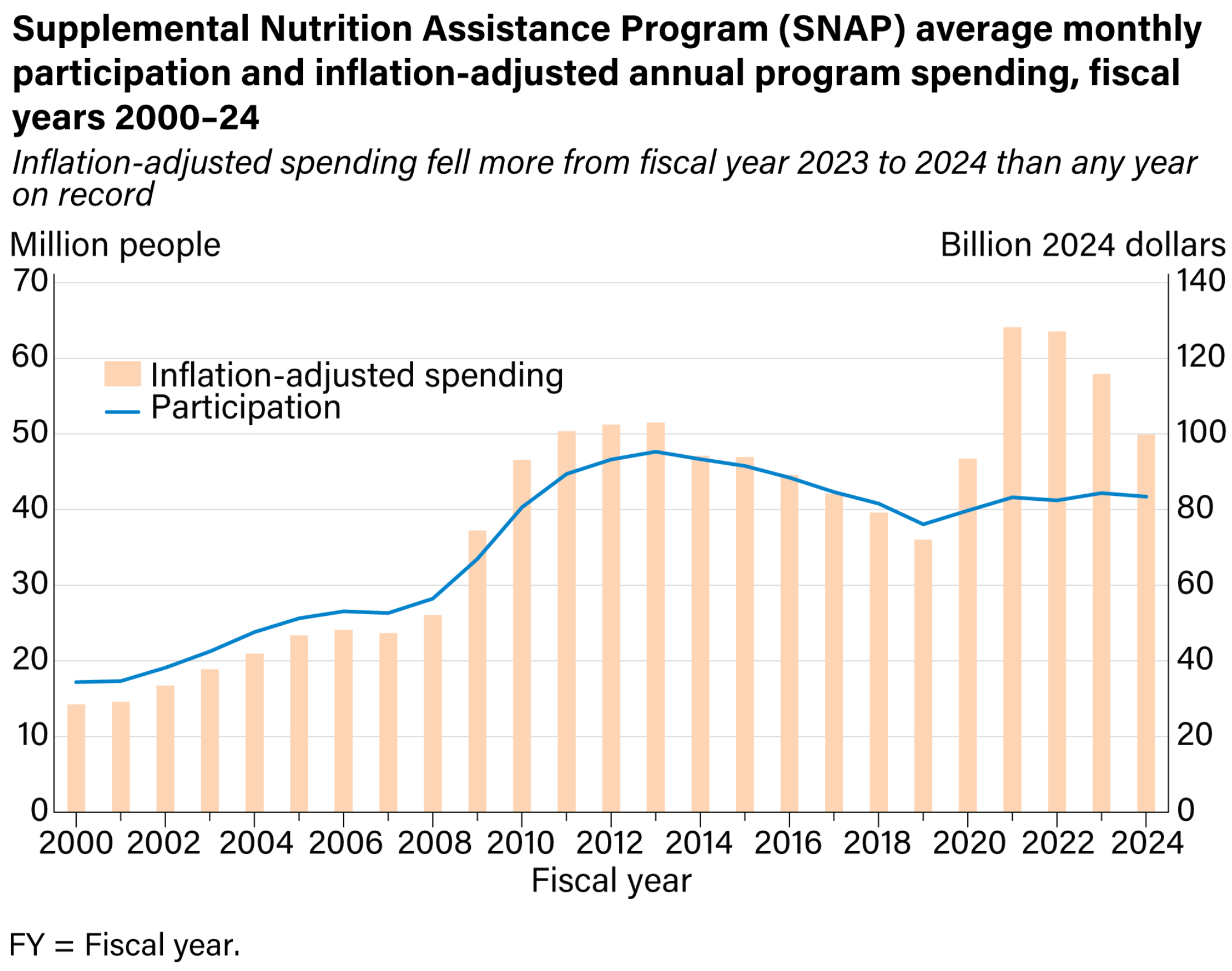
From 2021 to 2024 SNAP expenditures have fallen while the number of participants has remained unchanged. The net result is fewer food dollars per participant. Source: USDA Economic Research Service. Fair use.
One million children and three million adults are at risk of losing food support. As our government is working to make the poorest among us hungrier, programs in Western Europe should make Americans blush with shame. The European Union of 27 countries mixes programs with national efforts to fight hunger, supporting food banks, surplus food distribution and school meals. In France supermarkets are mandated to make food donations, addressing both hunger and food waste.
When will our country’s leaders learn to defend the needs of its people?
We all would like our fellow human beings to have enough to eat. The main issue with SNAP is certainly not money cost, since it is a very small part of our national income. The classic issue in welfare is whether society provides help in money or in kind. From an economic efficiency point of view in theory it is better to give help in the form of money and allow the recipient to decide how to spend it, but the other side of this is that the recipient may decide to spend the money in a way that society does not approve of. SNAP does not completely prevent this because money is fungible and a household that has to spend less of their other income on food can spend more of it on other things to some degree, and in particular on things the society does not approve of.
The provision of aid in kind or partially in kind runs into another problem. Unless the aid is provided universally to everyone in the society, as what economists call a "public good", some eligibility criteria are necessary to decide who can receive the benefit. These criteria almost always involve money income levels, and as a result give rise to unintended disincentives, as when a household faces the choice between an opportunity to increase its money income from other sources, but will lose eligibility for SNAP as a consequence. These effects are often called "poverty traps", since they tend to make it more difficult for households to improve their income standing in the market economy.
This nation is in such debt, they're just trying to free up money to help replace their arsenal of bombs and missiles. Food on the table for "useless eaters" is a waste. It's just another fine example of doofus-cit spending. The cost of troops to protect supermarkets from looting will be much higher than a few billion bucks for SNAP. Cheaper ALDI desserts ain't gonna save us.